How marvnBoost Beats the #1 AI Writing Tell
AI-written content has a tell that has nothing to do with facts or grammar: it drones in one rhythm. Here's the measurement system we built to catch it, and the production data proving it works.
 Victoria Buttigieg
The Tell Everyone Talks About But Rarely Names
Ask someone why a piece of writing "feels like AI" and most people can't say exactly why. They just sense it. It's rarely a factual error or a grammar slip. More often it's something subtler: sentence after sentence lands at roughly the same length, usually a long one, and the text starts to drone.
This isn't just a gut feeling, either. Ryan Levesque recently wrote about the shape of AI Slop vs. Human Writing, pointing to a University of Maryland and Google DeepMind study that found AI-generated writing has a detectable structural "shape" distinct from human writing, one accurate enough to tell the two apart 93% of the time. Sentence rhythm is one of the clearest fingerprints of that shape.
Take this sample from one of our first content generations back in April as an example:
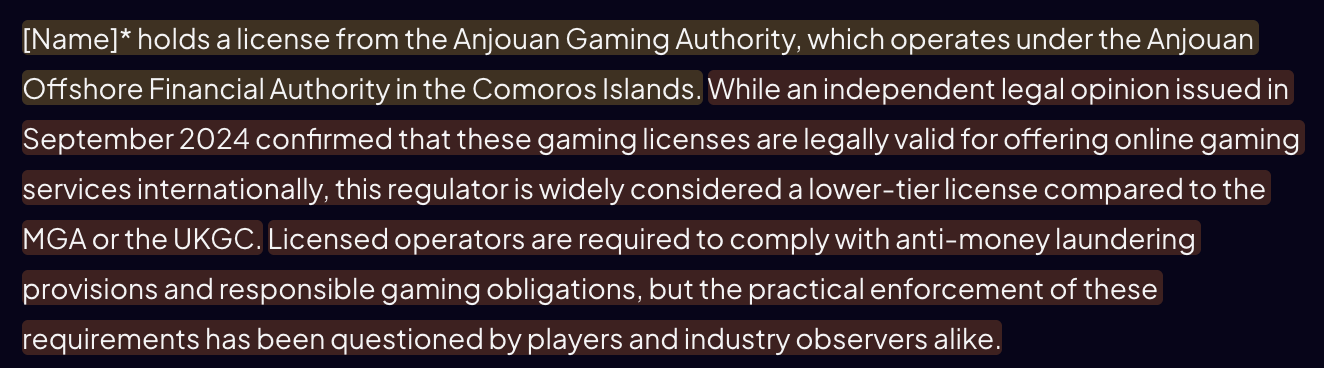
All sentences are longer than 20 words, with the longest one being 44 words long. In fact, the article had five or more consecutive sentences of similar length. Read enough paragraphs like that and the content will inevitably sound dull.
Why AI Writes in One Gear
Language models generate one token at a time, each chosen for being the most statistically likely next word given everything before it. There's no step where the model plans flow or rhythm. Trained across enormous volumes of average, well-formed prose, that token-by-token process tends to settle into whatever sentence length was most common in training, then repeats it, because nothing in the generation process rewards contrast between one sentence and the next.
The result is a kind of statistical regression to the mean: not wrong, not badly written, just flattened. It's the same reason AI-generated lists so often default to three items or AI images default to symmetric compositions. Without an explicit push toward variation, the most probable output is also the most average one.
What Rhythm Actually Means
We use three related terms, worth defining precisely:
Rhythm: the pattern of sentence lengths as you read through a text.
Burstiness: the statistical measure of the variation in sentence length and structure within a text. Human writing is naturally "bursty"; AI writing tends to be uniform, and it's one of the two core signals AI-detection tools look for.
Flow: the reader-facing effect of good rhythm. Public tools like WordCounter.net now score it directly, with guidance to mix short, medium, and long sentences to please the reader's ear.
The clearest illustration of the idea remains Gary Provost's "This sentence has five words" passage. It’s a demonstration of how uniform sentences drone while varied ones create music. It's a good anchor for readers new to the concept.
How Rhythm is Added to the marvnBoost Content Pipeline
All articles move through a series of stations: research, planning, writing, fact-checking, polish. Rhythm isn't treated as a cosmetic pass tacked on at the end; it's a standard the writing itself is held to throughout, the same way a human editorial team would keep an eye on pacing as a piece comes together rather than fixing it only after the fact.
That "how it should read" isn't a guess. It's grounded in a real distribution pulled from human-written reference articles: roughly one-fifth short sentences, half medium, just under a third long, with very long sentences close to zero. Early on, we tried chasing a single average number instead of that shape, and it backfired. Optimizing for a target number instead of a shape produces its own pathologies: either everything flattens to hit the average or you get a mechanical "sawtooth" pattern that's just a different kind of monotony.
The Guardrails - Why We Don't Just Chop Everything Short
Two guardrails stop the system from over-correcting into a different machine pattern:
Anti-choppiness guard: short sentences only work sparingly. If the system notices too many, it stops adding them.
Anti-sawtooth guard: detects mechanical short-long-short-long alternation and blocks it, since human variation is irregular by nature.
Benchmarking Against a Tool Anyone Can Run
Each article is also scored with our own sentence length variation checker. It’s a faithful replica of WordCounter.net's public Flow Score (0–100%), which anyone can verify independently. We target that tool's own pass line of 70, and deliberately stop pushing past it, because chasing a higher score forces exactly the mechanical alternation the guardrails exist to prevent. For context: genuinely human-written reference articles in the iGaming niche score in the mid-to-high 60s, so 70 means "comfortably human," not chasing the perfect score.
The Results, In Full
Before vs. after the system existed
We compared five production articles generated before the rhythm system released against five generated after, using the identical measuring code on the final saved articles:
Measurement | Before | After | Change |
|---|---|---|---|
Average sentence length | 23.8 words | 19.3 words | −19% |
Sentences > 35 words | 9.5% | 1.6% | −83% |
Sentences > 25 words | 39.7% | 24.9% | −37% |
Genuinely short sentences (under 8 words) | 3.4% | 6.4% | +89% |
Longest single sentence | 64 words | 47 words | −27% |
Article's opening sentence | 39 words | 27 words | −31% |
Worst paragraph opener | 54 words | 46 words | −16% |
The pattern is exactly the intended one: the heavy tail of marathon sentences almost disappears, short punchy sentences roughly double, and the article's opening - the first thing a reader (or an editor evaluating content) sees - gets dramatically tighter. Meanwhile, overall sentence length variation held steady rather than collapsing, meaning that the system trimmed the extremes without flattening the prose.
What the system fixes per article, in production today
Across 51 recent test runs, comparing each article as first drafted against its final generated version:
Measurement | First draft | Final article |
|---|---|---|
Worst paragraph opener | 48 words | |
Very long sentences (35+ words) | 4.7% | 0.9% (−81%) |
Short-sentence share | 20.5% | 23.0% |
Public Flow Score (70 = pass) | 67.8 | 68.2 |
Triggers "similar length in a row" warning | 16% of articles | 6% of articles |
Triggers "mix your lengths" warning | 14% of articles | 8% of articles |
There are two things worth noting. First, the drafts already start close to the human band because rhythm guidance is baked into the writing stage itself. Second, the Flow Score moves modestly by design: the system's job is to fix the specific worst offenders (marathon openers, monotone stretches) and land articles safely in the human band, not to inflate a metric.
Content comparison side-by-side
Let’s look at a real example. Consider these casino review samples from April and July of this year.
*Casino name is redacted and replaced with [Name].
April 2026 sample
The April sample runs just three sentences averaging 32 words each, all clustered tightly in the 22-44 word range with nothing shorter than "long." There's no short sentence to break the pace, and one line nearly hits 45 words. The result reads as one continuous register - dense, clause-stacked prose with no breathing room between ideas.
Sentence | Word count | Tier |
|---|---|---|
1 | 22 | Long |
2 | 44 | Very long |
3 | 30 | Long |
July 2026 sample
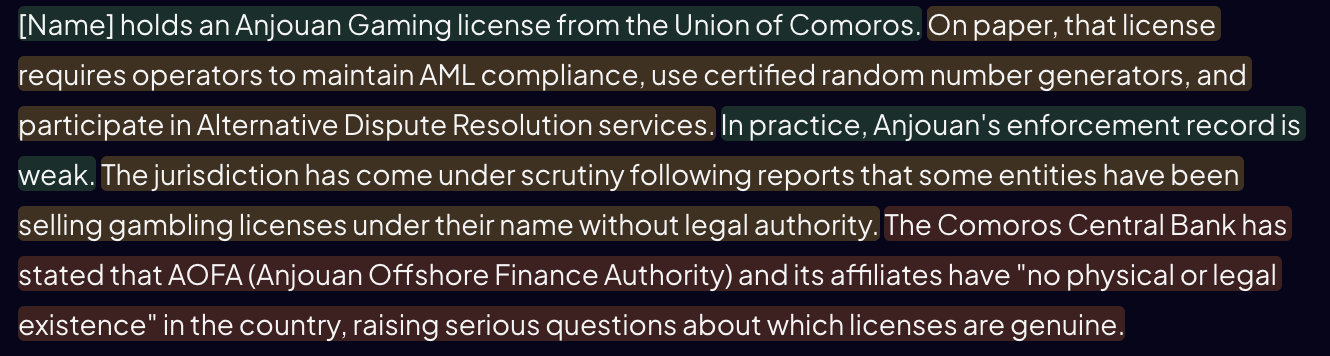
The July sample spreads the same ground across five sentences averaging 19.2 words, with a wide range from 7 to 32 that hits short, medium, and long. Sentence 3 - "In practice, Anjouan's enforcement record is weak." - lands as a genuine punch line right after two longer setup sentences, a classic short-after-long contrast. With more sentences carrying the load, each one bears less weight and the piece keeps moving.
Sentence | Word count | Tier |
|---|---|---|
1 | 12 | Medium |
2 | 22 | Long |
3 | 7 | Short |
4 | 23 | Long |
5 | 32 | Long |
The April version is grammatically fine but monotone. Three sequential sentences in the 22-44 word range are exactly the flat rhythm that’s a ‘AI tell’ The July version has real burstiness: it opens with a clipped fact (12 words), builds detail (22), snaps back short for emphasis (7), then extends again (23, 32). That short sentence at #3 is doing real rhetorical work. It's the pivot from "here's the official claim" to "here's the problem," and the brevity makes it land like a verdict.
When the flow score stays flat but the sentence bears less weight
The Flow Score doesn't always move with these changes, and that's worth showing plainly. Two reviews of the same casino - from April and July 2026 - both received a 77% flow score, but the difference in sentence length variation and ultimately readability is noticeable.
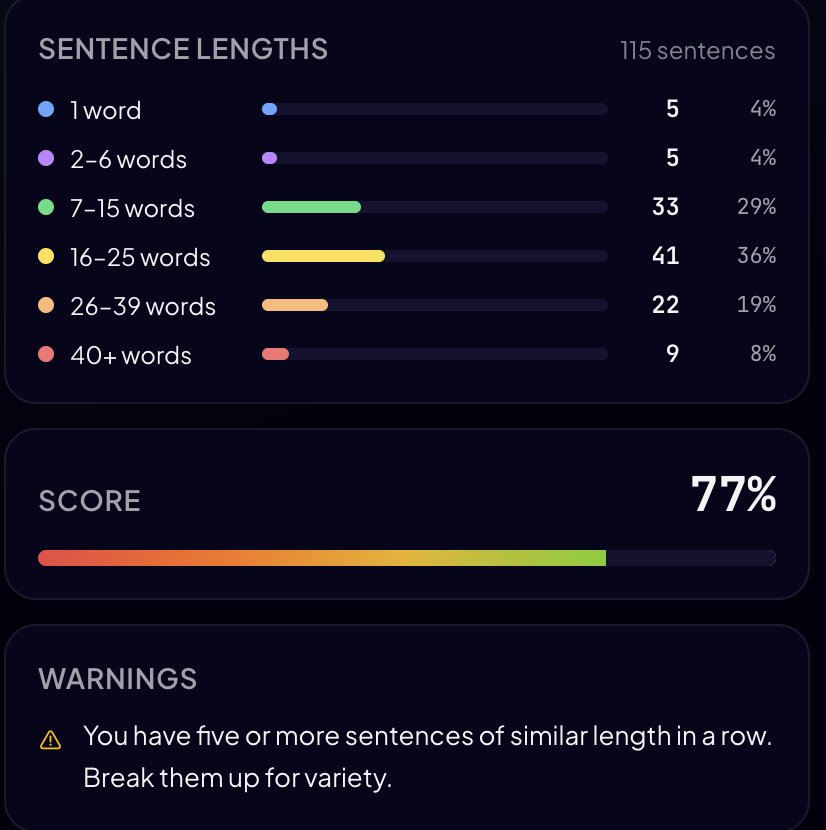 | 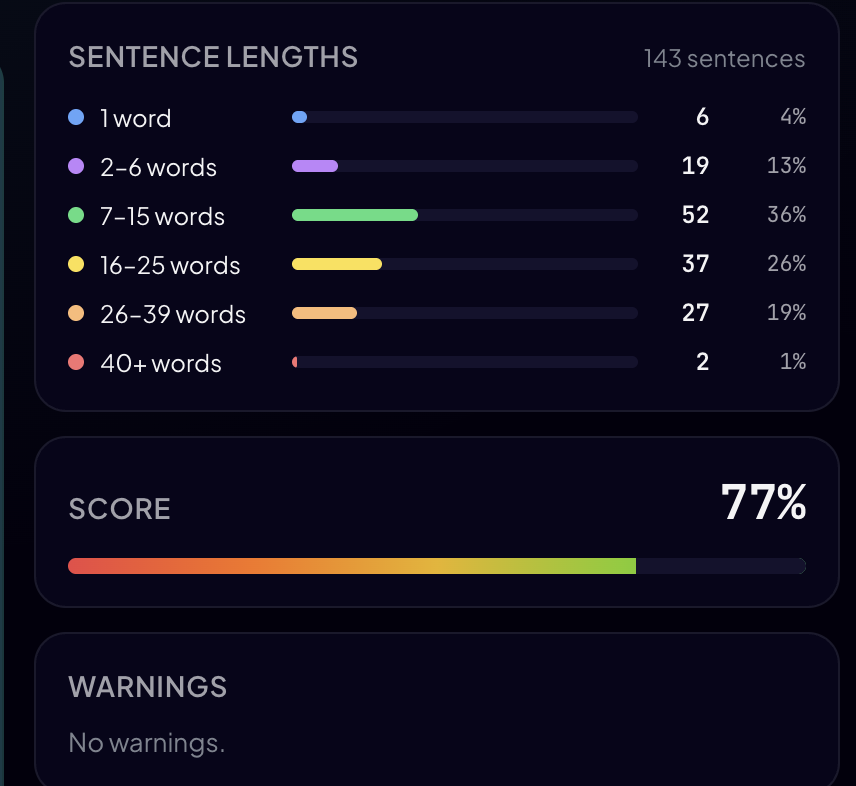 |
2,451 words, 115 sentences | 2,403 words, 143 sentences |
Measurement | April Casino Review | July Casino Review | Change |
|---|---|---|---|
Sentence count | 115 | 143 | +24% |
Short sentences (2-6 words) | 4% | 13% | +9pp |
Very long sentences (35+ words) | 8% | 1% | −7pp |
"Similar length in a row" warning | Triggered | Cleared | / |
It's the same lesson as the 51 tests mentioned above: the system's job isn't to inflate the score - it's to fix the specific things that read as machine-written. Sometimes that shows up in the score. Sometimes it only shows up in the article’s sentences, which is exactly where a human reader is looking anyway.
Try the same content system: marvnBoost
Every article the marvnBoost content pipeline produces runs through this rhythm system by default - no setup, no extra step. You don't need to ask for "more human-sounding" content; it's the baseline every generation is held to before it reaches you.
If you want to see it for yourself, paste any marvn Discover or marvnBoost article into WordCounter.net's Flow Score tool. It's the same public benchmark we hold our own pipeline to, so you're not taking our word for it - you're checking it against the independent yardstick we use internally.
And if you’d like to start using marvnBoost, the content engine built for iGaming, sign up today from €100/month for 35,000 words/month. Or contact us or book a demo if you’re after a custom solution built around your workflow and specifications.